
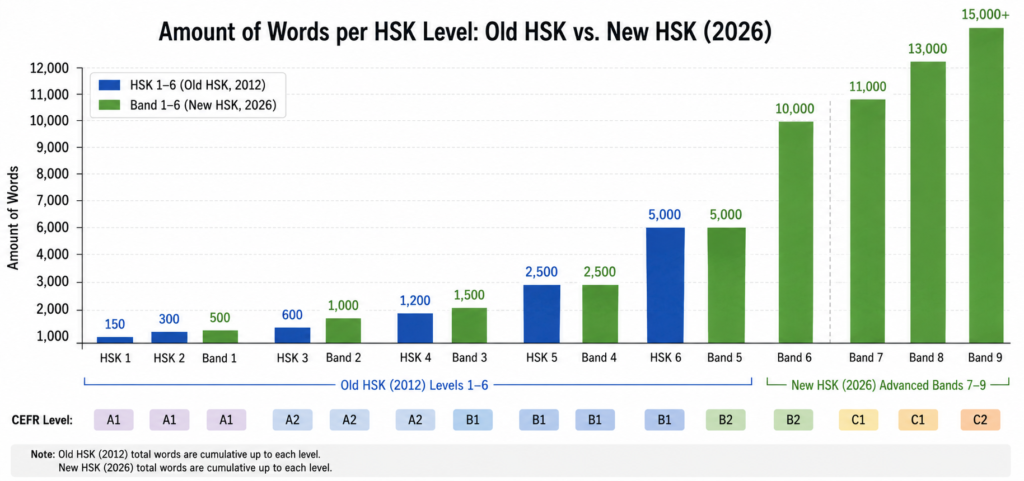
When people compare CEFR levels with the old HSK and the new HSK 3.0, it often feels like the numbers should match—but they don’t. You might see “HSK 4 = B1” in one place and “HSK 4 = B2” somewhere else, and both can look “correct.” This is confusing for learners, but the reason is actually quite simple: these systems were built in very different ways, for different goals.
CEFR (the European system) is based on what you can do with a language. It asks questions like: Can you order food? Can you explain your opinion? Can you understand a news article? It focuses on real communication in everyday life. So CEFR levels describe practical ability, not just knowledge.
The old HSK system was very different. It mostly measured how many Chinese words you know. For example, if you knew a certain number of words, you could pass HSK 3, 4, 5, and so on. This made it quite simple to study for, because you could focus on memorizing vocabulary lists. But the problem is that knowing words does not always mean you can actually use them in real conversation. You might “pass” a level but still struggle to follow fast spoken Chinese or speak naturally.
This is the main reason CEFR and old HSK don’t match well: one measures real-life skills, the other mainly measures vocabulary size.
Now HSK 3.0 tries to fix this. It adds more focus on listening, speaking, reading, and writing, not just vocabulary. It also increases the number of words learners are expected to know. In that way, it is closer to CEFR than the old system. But it still is not a perfect match, because it is designed specifically for Chinese learners and Chinese education goals, not as a global standard like CEFR.
Another reason the systems don’t line up is that languages are not equally “difficult” in the same way. Chinese uses characters instead of an alphabet, and tones change meaning in speech. These things are not part of CEFR, which was mainly designed with European languages in mind. So the same “level” in two systems does not always represent the same learning challenge.
There is also a practical issue: each system is used for different reasons. CEFR is used in schools, universities, and immigration systems across Europe. HSK is used for Chinese university admission, scholarships, and Mandarin certification. Because they serve different purposes, they were never designed to match perfectly.
So when you see comparisons like “HSK 4 equals B1,” it is really just a rough guide. It helps learners get a general idea, but it is not an exact translation.
The simplest way to think about it is this: CEFR is about how well you can use a language in real life, while HSK (especially the old version) is more about how much Chinese you know. HSK 3.0 tries to bring these two ideas closer together, but there will always be some mismatch.
In the end, the levels are helpful for orientation, but they are not universal “equal numbers.” They are more like different maps of the same landscape, drawn with different priorities.