

What if the secret to mastering the world’s most spoken language isn’t an exhausting three-hour marathon, but a simple 15-minute tea break? Many British learners feel defeated before they even begin. You see the intricate characters. You hear the shifting tones. It feels like trying to climb Everest in a pair of slippers. It’s why finding a manageable mandarin study plan for beginners is essential for your peace of mind.
You’ve likely been told that Chinese requires hours of daily grind. It doesn’t. We’ve designed a structured routine that fits perfectly into the small gaps of your busy schedule. This approach prioritises calm consistency over intense effort. You’ll discover how to master the foundations of HSK 3.0 whilst maintaining your emotional comfort. Success is inevitable when the steps are small enough. There is no need for exhausting effort when you have a reliable system.
This guide provides a clear roadmap for your first steps. We’ll outline how to organise your daily 15-minute block to build genuine conversational ability and reading confidence. Stop worrying about the mountain. Start enjoying the climb, one manageable step at a time.
Key Takeaways
- Replace the stress of long, exhausting study sessions with a calm, 15-minute daily habit that prevents early burnout.
- Implement a structured mandarin study plan for beginners that uses narrative-driven stories rather than rote memorisation to master characters.
- Organise your week into clear phases of focused vocabulary input and narrative reinforcement for steady, natural progression.
- Align your learning with the 2026 HSK 3.0 standards to ensure you are mastering the most relevant vocabulary for modern conversation.
- Eliminate decision fatigue with a digital membership that provides a streamlined, all-in-one environment for your daily practice.
Table of Contents
- Why most Mandarin study plans fail beginners
- The three pillars of a sustainable Mandarin routine
- Organising your week: A beginner 15-minute schedule
- Navigating HSK 3.0 characters and tones
- How a Fluent15 membership simplifies your journey
Why most Mandarin study plans fail beginners
Most beginners start with a burst of energy. They clear their Sunday afternoon. They sit down for two hours of intense study. By Monday morning, the momentum is gone. This is the trap of intensity. A traditional mandarin study plan for beginners often asks for too much, too soon. It ignores the reality of a busy British lifestyle. When you face a mountain of choices every morning, you experience decision fatigue. What should I study today? Tones? Characters? Grammar? If you have to decide, you’ve already lost. The mental energy spent choosing is energy stolen from learning. You need a plan that removes the guesswork and provides a clear path forward.
The trap of intensity over consistency
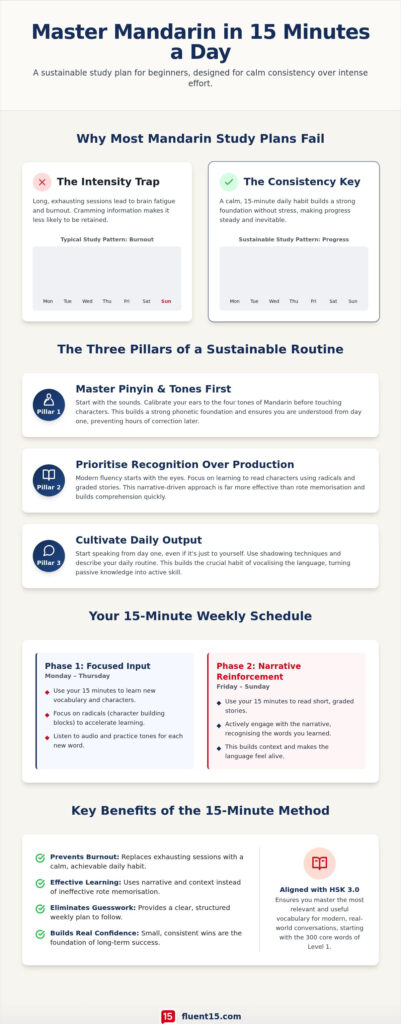
Studying for seven hours on a Sunday is less effective than fifteen minutes every day. Why? Brain fatigue. Standard Chinese is a tonal language. Your brain needs time to process these new frequencies. It needs sleep to cement the patterns. Cramming leads to a mental wall where nothing sticks. Small wins are the real currency of the first thirty days. The goal isn’t total fluency. It’s the daily habit. A 15-minute micro-habit is the gold standard for long-term progress. It’s manageable. It’s sustainable. It’s the bridge to genuine confidence. It replaces the stress of “doing enough” with the calm of “doing something.”
Tackling the “Mandarin is too hard” mindset
Fear is often louder than logic. You might fear the characters. You might fear the four tones. But logic tells a different story. Modern digital tools have transformed how we see characters. You don’t need to spend hours with a physical brush and ink. Recognition is the priority. Narrative engagement replaces rote memorisation. Mandarin is a logical, grammar-simple language that lacks the complex conjugations found in many European tongues. Once you strip away the intimidation, you find a system that makes sense. Finding a mandarin study plan for beginners that focuses on logic over fear is the first step. It’s not about working harder. It’s about working smarter within a structured environment. Passive listening won’t save you. Active narrative engagement will. Don’t just hear the sounds. Follow the story. This shift from passive to active is what makes the 15-minute habit so powerful. It keeps your mind sharp without the burnout of traditional methods.
The three pillars of a sustainable Mandarin routine
Success isn’t about luck. It’s about structure. A robust mandarin study plan for beginners rests on three specific pillars that protect your time and energy whilst ensuring you aren’t just busy. These pillars remove the chaos of traditional methods. They replace “trying hard” with “moving forward.” By focusing on phonetics, recognition, and consistent output, you build a foundation that won’t crumble when life gets hectic. This is how you transition from a curious beginner to a confident communicator.
Mastering Pinyin and tones early
Start with the sounds. Spend your entire first week exclusively on the four tones. Do not touch a character yet. Your ears need to calibrate to native frequencies before your eyes take over. Use digital audio to hear the subtle shifts in pitch. When you speak, practice “exaggerated speaking.” Be loud. Be bold. Stretch the tones further than you think is necessary. This over-correction builds the muscle memory required for natural speech later on. It’s the most efficient way to ensure you are understood from day one. Calibrating your ears now prevents countless hours of correction later.
Characters: Recognition over production
Forget the ink and paper for now. Modern fluency starts with the eyes, not the hand. We advocate for learning to read characters long before you attempt to write them by hand. Why? Because you’ll encounter thousands of characters in your daily digital life before you ever need to use a physical pen. Focus on radicals first. These are the building blocks of the language. They provide clues to meaning and sound. Use graded readers to see these blocks in context. Reading a story at your exact level beats rote flashcard memorisation every time. It builds narrative flow. It makes the language feel alive rather than like a list of isolated data points.
Daily output is your third pillar. You don’t need a live tutor to start speaking today. Talk to yourself. Describe your morning routine in simple sentences. Use “shadowing” techniques to mimic the native speakers in your digital materials. This builds the habit of vocalising the language every single day. All of this is guided by the HSK 3.0 framework. It provides a globally recognised roadmap for your journey. It ensures the 300 words you learn at Level 1 are the most useful ones for real-world interaction. If you want a system that organises these pillars for you, explore our Mandarin Membership Plans. It’s the simplest way to follow a mandarin study plan for beginners without the stress of planning it yourself.
Organising your week: A beginner 15-minute schedule
A 15-minute block isn’t a compromise. It’s a strategy. Most learners fail because they lack a rhythm. They treat study like a chore rather than a natural part of their day. A successful mandarin study plan for beginners divides the week into manageable phases to prevent burnout. This rhythmic approach ensures you are always moving forward without feeling the weight of the journey. You don’t need a massive window of time. You just need a consistent one.
Monday to Wednesday are your input days. This is when you engage with new vocabulary and grammar points. It’s about growth. Thursday and Friday shift to reinforcement. You dive into graded reading. You follow the narrative flow of a story. It’s about cementation. The weekend is for low-stakes immersion. Listen to a Chinese podcast whilst you walk the dog. Watch a short video on your phone. This keeps the language fresh without the pressure of a formal session. Progress tracking is simple: did you show up? Avoid the trap of “perfect” scores. A 70% retention rate is a victory if it means you come back tomorrow.
The 15-minute daily breakdown
Efficiency requires a timer. Spend minutes 1 to 5 reviewing yesterday’s most difficult character or tone. This clears the mental fog. Minutes 6 to 12 are for new content engagement. This is where your digital membership does the heavy lifting. You follow the structured path already laid out for you. Finally, use minutes 13 to 15 for a quick oral summary. Speak out loud. What did you just learn? This final act of output turns passive data into active knowledge. It’s the most important part of the session.
Adapting the plan for your lifestyle
Life in the UK is fast. Your study plan should be faster. Fit your 15 minutes into a train commute or a quiet lunch break at the office. The location doesn’t matter as much as the focus. Use the “never miss twice” rule. If life gets in the way on Tuesday, make Wednesday non-negotiable. This prevents a single slip from becoming a permanent stop. Keep your study environment digital and distraction-free. By using a phone or tablet, you remove the need for heavy bags or cluttered desks. You simply log in, focus, and finish. Success is inevitable when the habit is this easy to maintain.
Navigating HSK 3.0 characters and tones
HSK 3.0 is the official standard for 2026. It’s your map. For a new learner, it narrows the focus to just 300 essential words for Level 1. This is a massive relief. It stops you from “dictionary diving” into obscure words you don’t need yet. Your mandarin study plan for beginners should prioritise these high-frequency terms. Why waste time on linguistic clutter? Focus on what matters. Use HSK 3.0 graded readers online to see these words in action. Context is the glue that makes them stick. It turns isolated data into a living story.
The logic of Chinese characters
Characters are not random pictures. They are a logical system. Think of radicals as the alphabet of characters. They provide the DNA of every word. Use stories to “glue” a character’s meaning to its sound. When you see a radical, you see a hint. It’s like a puzzle where you already have the edge pieces. This makes recognition feel natural rather than forced. You aren’t memorising lines. You are recognising patterns. The radical system is the alphabet of characters that reveals the underlying meaning of every new word you meet.
Tone pairs: The secret to being understood
Tones are often the biggest fear for British learners. But there’s a secret. Learn them in pairs. Native speakers rarely say words in isolation. Learning pairs mimics the natural rhythm of Standard Chinese. It helps you master the “neutral tone” which acts like a soft landing between sounds. Practice these pairs daily to build your oral confidence. It’s the fastest way to ensure you are actually understood. Simple exercises like mimicking two-syllable phrases can calibrate your pitch perfectly. You don’t need to be perfect. You just need to be consistent.
Ready to stop guessing and start growing? A structured approach removes the stress of the unknown. If you want a plan that organises this logic for you, explore our Mandarin Membership Plans and begin your journey with clarity.
How a Fluent15 membership simplifies your journey
Why struggle with a scattered approach? Many learners spend more time hunting for resources than actually learning. They bounce between apps. They collect dusty materials. They lose momentum in the search. A Fluent15 membership replaces this chaos with a single, streamlined digital platform. It’s a “plan in a box.” Everything you need is already here. No hunting. No guessing. Just progress. This is the most efficient way to maintain a mandarin study plan for beginners without the mental load of self-curation.
Our approach is built for the busy British professional. You don’t need to schedule your life around another person’s availability. You don’t need to pay the high fees of one-on-one sessions that often lack a structured curriculum. Instead, you get 24/7 access to a system that works at your pace. It’s cost-effective. It’s consistent. It’s designed to fit into the small gaps of your day, regardless of where you are in the country. Success isn’t about intensity. It’s about having a reliable partner for the long-term journey.
The power of a pre-built curriculum
Decision fatigue is the silent killer of fluency. “What should I study today?” is a question that drains your willpower before you even begin. We’ve removed that hurdle. Fluent15 organises HSK 3.0 materials into manageable daily bites. You simply show up. You follow the path. The digital environment tracks your progress automatically, showing you exactly how far you’ve come. It turns a complex language into a series of small, achievable victories. You focus on the discovery. We handle the logistics.
Starting your Mandarin journey today
The best time to start was yesterday. The second best is now. There’s no need to wait for a “perfect” moment that never arrives. You can begin building your 15-minute habit in the time it takes to boil a kettle. Join a community of like-minded UK learners who value efficiency and calm progression. Experience the freedom of a system that respects your time and your intelligence. It’s time to stop overcomplicating the process. It’s time to start seeing results. Start your 15-minute Mandarin habit with Fluent15 and transform how you engage with the world’s most spoken language.
Begin your 15-minute journey today
Mastering Mandarin doesn’t require a lifestyle overhaul. It requires a better rhythm. By focusing on consistency over intensity, you turn a daunting task into a series of calm, manageable steps. We’ve explored how a structured mandarin study plan for beginners removes decision fatigue and prioritises the logic of HSK 3.0. You now have the roadmap. You understand the pillars of phonetics and narrative recognition. The only step left is to start.
Fluent15 provides a digital-first learning platform designed specifically for busy UK professionals. Our structured HSK 3.0 curriculum does the thinking for you; this allows you to focus entirely on your progress. Why wait for a “perfect” time that never comes? You can build a life-changing habit in less time than it takes to check your morning post. Join Fluent15 and start your Mandarin membership today. Success is inevitable when you take it one small step at a time. Your journey to fluency begins with these first fifteen minutes.
Frequently Asked Questions
Is Mandarin really the hardest language for a beginner to learn?
Mandarin isn’t the hardest language. It’s just different. British learners often find the grammar surprisingly simple. There are no gendered nouns. There are no complex verb conjugations. The difficulty lies in the tones and characters. If you follow a structured mandarin study plan for beginners, these become manageable patterns. It’s about shifting from fear to curiosity. Success is inevitable when you break the mountain into small pebbles.
How many characters do I need to know to be “fluent” in Mandarin?
Fluency is a broad target. For daily life, knowing 2,500 characters allows you to read most newspapers. But don’t let that number intimidate you. HSK 3.0 Level 1 requires just 300 words. These are the building blocks of every conversation. Focus on recognition first. You don’t need to write them by hand to understand them. Mastering these few hundred words will give you immense confidence in your daily interactions.
Can I learn Mandarin online without a live tutor?
You can certainly learn Mandarin online without a live tutor. Modern digital memberships provide the structured path you need. You get the audio feedback and visual cues required to master tones. Coordination is no longer an issue. You don’t have to schedule your life around a teacher’s diary. By using native audio recordings, you calibrate your ears at your own pace. Consistency in a digital environment often beats sporadic tutoring sessions.
What is the difference between HSK 3.0 and the old HSK system?
HSK 3.0 is the updated official standard for Chinese proficiency. It expanded the previous six-level system into nine levels. For a beginner in 2026, it refines the vocabulary to be more relevant. Level 1 now requires 300 essential words. This update makes the entry point more accessible whilst ensuring the grammar is practical. It provides a clearer roadmap for your long-term journey. It’s a modern system for a modern world.
How long does it take to reach HSK Level 1 with 15 minutes of study a day?
Most learners reach HSK Level 1 in four to six months. This assumes you stick to a consistent 15-minute daily habit. A focused mandarin study plan for beginners ensures you aren’t wasting time on irrelevant data. You focus on the 300 core words. You master the four tones. Small, daily victories prevent the burnout that kills motivation. By the end of this period, you’ll feel comfortable with basic reading and speaking.
Do I need to learn how to write characters by hand?
You don’t need to learn handwriting for practical fluency. In our digital age, typing via Pinyin is the standard. It’s how we send emails. It’s how we text. Focus your energy on character recognition instead. Reading allows you to consume stories and media much faster. Handwriting is a beautiful skill, but it’s not a requirement for most learners. Save your time for speaking and reading to see faster results.
What are the best resources for Mandarin graded reading practice?
Digital graded readers are your best resource. These stories use controlled vocabulary matched to your specific HSK level. They allow you to see characters in context rather than in isolation. This reinforces grammar naturally. Look for platforms that offer narrative-driven content. Avoid opening a dictionary for every unknown word. Reading at your level builds a sense of flow. It makes the language feel like a story rather than a list.
How do I stay motivated when the initial excitement of learning fades?
Motivation is a feeling. Habit is a system. The secret is to make your study session so short that it’s impossible to skip. Focus on the “small wins” of your 15-minute block. Recognising a character on a menu is a victory. Understanding a song lyric is a win. By using a pre-built curriculum, you remove the stress of deciding what to do. Habit beats intensity. Consistency beats excitement every time.