
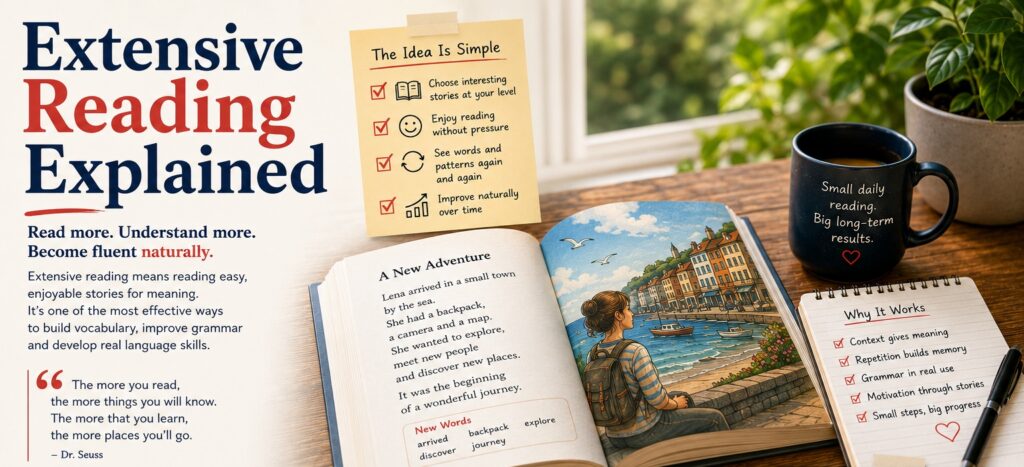
What if becoming better at a language wasn’t about studying harder, but simply about reading more?
A Different Way to Learn
For many language learners, studying means memorising vocabulary, completing grammar exercises and preparing for the next test.
While these activities have their place, they often leave learners with an unexpected problem.
They know a lot about the language, but they still struggle to use it naturally.
There is another approach that has been transforming language classrooms for decades: extensive reading.
The idea is surprisingly simple.
Read large amounts of material that you can already understand and genuinely enjoy.
Instead of treating every page as a lesson, you treat it as a story.
What Is Extensive Reading?
Extensive reading means reading easy, enjoyable texts for meaning rather than studying every individual word.
The focus is on understanding the story, not analysing the language.
Imagine picking up a novel written for learners at your level.
You recognise almost all the vocabulary, understand the plot and only encounter a few unfamiliar words.
Rather than stopping to look up every new word, you keep reading.
Most of the time, the story itself helps you understand the meaning.
Over time, those words become familiar through repeated exposure.
That is extensive reading.
Why Easy Is Better
Many learners believe they should always challenge themselves with difficult books.
In reality, reading material that is too difficult often slows progress.
If every sentence contains unfamiliar words, reading becomes frustrating.
Your attention shifts from understanding the story to constantly translating.
Extensive reading works because the material is easy enough to enjoy.
Language experts often recommend choosing texts where you already understand about 95–98% of the words.
That allows your brain to focus on meaning while naturally picking up new vocabulary along the way.
Reading should feel comfortable, not like an exam.
Learning Without Realising It
One of the biggest advantages of extensive reading is that learning happens almost automatically.
As you follow characters through different situations, you repeatedly encounter common words and grammar patterns.
The same expressions appear again and again.
A traveller buys a ticket.
A waiter brings the menu.
A friend asks a question.
Because these words appear in meaningful situations, your brain gradually stores them without conscious effort.
You are learning because you are reading—not because you are trying to memorise.
Vocabulary Grows Naturally
Vocabulary lists often teach words in isolation.
Extensive reading teaches them in context.
Suppose you come across the word journey several times.
First, someone begins a journey.
Later, another character talks about a long journey.
Finally, someone reflects on the journey they have completed.
Without studying a definition, you begin to understand exactly how the word is used.
The more stories you read, the richer these connections become.
Eventually, words feel familiar because you have experienced them many times.
Grammar Through Exposure
Grammar is another area where extensive reading shines.
Instead of memorising rules before using them, learners repeatedly see grammar in action.
You notice how past tense verbs are formed.
You become familiar with common sentence patterns.
You recognise expressions that native speakers use naturally.
After enough exposure, many grammar structures simply “sound right.”
This doesn’t replace grammar study completely, but it makes grammar far easier to understand because you have already seen it in real communication.
Motivation Matters
Perhaps the greatest strength of extensive reading is that people actually enjoy it.
Traditional study sessions can feel like work.
Stories create curiosity.
You want to know what happens next.
You become invested in the characters.
Reading changes from a task into a hobby.
And when learning becomes enjoyable, consistency follows naturally.
That consistency is what leads to long-term progress.
Small Reading Sessions, Big Results
Many people imagine that extensive reading requires hours every day.
It doesn’t.
Even fifteen minutes of reading can expose you to hundreds of words and dozens of useful sentence patterns.
Over weeks and months, those short sessions accumulate into hundreds of pages.
The key is regular exposure.
Small daily habits almost always outperform occasional marathon study sessions.
How Fluent15 Uses Extensive Reading
Extensive reading is at the heart of the Fluent15 Method.
Every story is carefully graded so learners can read comfortably at their current level.
Instead of overwhelming readers with difficult vocabulary, each story introduces only a small number of new words while reinforcing familiar ones.
Those words return naturally in later stories, giving learners repeated exposure without boredom.
As learners progress through the courses, the stories gradually become longer and more sophisticated.
Vocabulary grows.
Grammar becomes more natural.
Confidence increases.
The learner hardly notices the transition because it happens one enjoyable story at a time.
Read More, Learn More
There is no shortcut to learning a language.
But there are methods that make the journey more enjoyable and more effective.
Extensive reading is one of them.
By reading material that is interesting, understandable and appropriate for your level, you give your brain exactly what it needs: meaningful, repeated exposure to real language.
You stop studying isolated words.
You stop worrying about every grammar rule.
Instead, you begin doing what successful language learners have always done.
You read.
And with every story, the language becomes a little more familiar.
Key Takeaways
- Extensive reading means reading easy, enjoyable material for meaning.
- Choose texts that you mostly understand.
- Vocabulary grows naturally through repeated exposure.
- Grammar becomes familiar by seeing it used in context.
- Enjoyable reading builds motivation and long-term habits.
- Consistency matters more than intensity.
- Reading regularly is one of the most effective ways to build lasting language skills.
Continue Reading
Want to learn more about the Fluent15 Method?
Continue with:
- The Fluent15 Method
- Why Stories Work
- Why We Don’t Memorize Vocabulary Lists
- Why 15 Minutes Is Enough
Or explore one of our graded reading courses and discover how extensive reading can help you become a confident reader—one story at a time.