
Why China’s Four Great Classical Novels Still Matter Today
Over the coming months, we are delighted to begin publishing graded readers based on China’s Four Great Classical Novels (四大名著, Sì Dà Míngzhù). These carefully adapted editions are designed for learners of Chinese, making some of the world’s greatest stories accessible without losing the spirit of the originals.
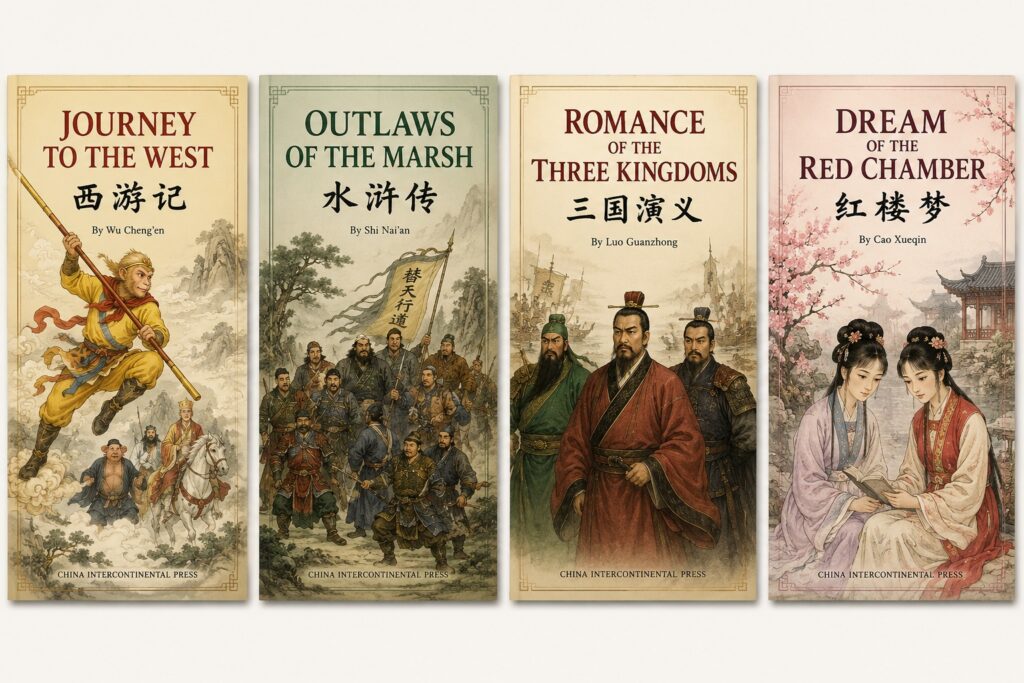
The four novels were written between the 14th and 18th centuries: Romance of the Three Kingdoms (c. 1400), Outlaws of the Marsh (c. 1375), Journey to the West (c. 1592), and Dream of the Red Chamber (c. 1791). Together, they form the foundation of classical Chinese fiction and continue to influence literature, entertainment, education, and even everyday conversation.
“When I was a child, my grandfather told me stories about the Monkey King before I was old enough to read,” recalls Li Wen, a secondary school Chinese teacher in Shanghai. “Years later, I finally read the original novel. It was much more complex than I had imagined, but it still felt like coming home.”
Stories like this are common across China. Long before many children open one of the country’s literary classics, they already know its heroes. They have seen them in cartoons, television dramas, films, computer games, or heard them from parents and grandparents.
For many people outside China, these novels can seem intimidating. They are long, filled with unfamiliar names, and rooted in a culture that stretches back hundreds of years. Yet readers who take the first step often discover something surprising: the stories feel remarkably modern.
“People expect ancient literature to be slow and difficult,” says Emma Collins, a university student from Canada who is studying Mandarin. “Instead, I found adventure, politics, romance, comedy and characters that still feel real. I was amazed that a book written centuries ago could be so entertaining.”
Perhaps the best-known of the four is Journey to the West, thanks largely to its unforgettable hero, Sun Wukong, the Monkey King. Clever, rebellious and blessed with extraordinary magical powers, he has become one of the most recognisable figures in Chinese culture. While the novel follows the Buddhist monk Xuanzang on his pilgrimage to India, it is Monkey King’s energy, humour and determination that have captured readers’ imaginations for generations.
Not all of the classics rely on fantasy. Romance of the Three Kingdoms takes readers into one of the most turbulent periods in Chinese history. Its pages are filled with ambitious rulers, brilliant military strategists and shifting political alliances. Although based on historical events, the novel transforms history into an epic story about leadership, loyalty and the price of power.
“Many Chinese business leaders still quote ideas that come from Romance of the Three Kingdoms,” explains Li Wen. “The book isn’t just about war. It’s about understanding people, making decisions and thinking several moves ahead.”
Another classic, Outlaws of the Marsh, tells the story of ordinary people pushed to the edge by corruption and injustice. Forced outside the law, they form a brotherhood of 108 outlaws who challenge an unfair system. The novel asks difficult questions that remain relevant today. What is justice? Should loyalty always come before the law? Can a criminal still be a hero?
The fourth masterpiece, Dream of the Red Chamber, offers a very different reading experience. Rather than focusing on battles or adventures, it explores the private lives of an aristocratic family as its wealth and influence slowly disappear. Love, family expectations, social status and human emotion fill its pages with extraordinary detail.
Many literary scholars consider it the greatest novel ever written in Chinese. It is so rich in symbolism and social observation that an entire field of academic study, known as Redology, has developed around it.
“Reading Dream of the Red Chamber feels like entering another world,” says postgraduate student Chen Yu. “You don’t just learn about one family. You begin to understand how people thought, loved and lived during the Qing dynasty.”
Although these novels were written hundreds of years ago, they continue to evolve. Every few years, a new television adaptation introduces the stories to another generation. Video games borrow their heroes. Film directors reinterpret famous scenes. Schoolchildren memorise famous passages, while adults rediscover the books with fresh eyes.
For learners of Chinese, these classics offer something even more valuable. They provide a bridge between language and culture. Vocabulary learned from a textbook becomes meaningful when it appears in a story that millions of people already know. Idioms suddenly make sense because they originated in one of these novels. Historical references in newspapers, conversations or television programmes become easier to understand.
“I realised I wasn’t just learning Chinese,” Emma reflects. “I was learning the stories that so many Chinese people grew up with. That changed the way I understood the language.”
Perhaps that is the real reason the Four Great Classical Novels have survived for so long. They are not preserved simply because they are old or important. They endure because every generation finds something new in them. Whether it is the courage of the Monkey King, the strategy of Zhuge Liang, the honour of the Liangshan outlaws or the quiet sadness of the Jia family, these stories continue to speak to readers across cultures and centuries.
For anyone beginning the journey into Chinese literature, there could hardly be a better place to start.