
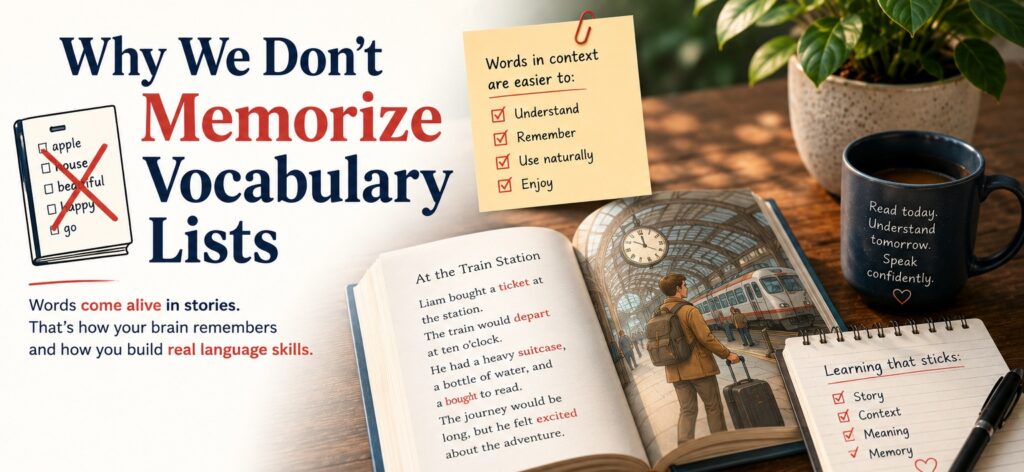
Learning thousands of isolated words might seem like the fastest path to fluency. In reality, it is often one of the least effective.
The First Thing Many Learners Do
When people begin learning a new language, they often buy a vocabulary book or download a list of the “1,000 most common words.”
It feels logical. After all, if you know more words, you’ll understand more of the language.
So learners spend hours memorising translations.
House = casa.
Eat = comer.
Beautiful = hermoso.
The problem isn’t that these words are wrong. The problem is that words rarely exist on their own.
Language is much more than a collection of definitions.
At Fluent15, we believe words are best learned where they naturally belong: inside stories.
Words Need Context
Imagine someone tells you the word bank.
What does it mean?
A place where you keep your money?
The side of a river?
A row of switches?
Without context, you don’t know.
Now imagine reading this sentence:
“Emma sat on the river bank and watched the ducks swim past.”
Suddenly, the meaning is obvious.
Context gives words their purpose. It shows how they are used, what they mean, and which other words they naturally appear with.
That is how our brains prefer to learn language.
We Remember Experiences, Not Lists
Think back to a holiday you enjoyed.
You probably remember the places you visited, the people you met and the conversations you had.
Now try remembering a shopping list from three months ago.
Much harder, isn’t it?
Stories work because they create experiences.
Instead of learning the word train, you remember the student rushing through the station to catch one.
Instead of memorising the word umbrella, you remember the family caught in the rain.
The vocabulary becomes connected to people, places and emotions.
Those connections make words much easier to recall.
Repetition Without Boredom
Vocabulary lists often rely on repeating the same word again and again until it sticks.
While repetition is important, repetition alone isn’t enough.
A story naturally brings important words back in different situations.
A traveller buys a ticket.
Later, the ticket is checked.
Finally, the ticket is collected at the station.
The learner encounters the same word several times, but each encounter adds a little more meaning.
This kind of repetition feels natural because it serves the story rather than the memory exercise.
Grammar Comes Along for the Ride
Vocabulary lists teach individual words.
Real language is made of sentences.
When you read stories, you don’t only learn what a word means. You also see how it behaves.
You notice which prepositions follow it.
You see whether it is formal or informal.
You learn common expressions without studying separate grammar rules.
Instead of learning dozens of isolated facts, your brain gradually builds an understanding of how the language works.
Active Understanding Beats Passive Recognition
Many learners can look at a vocabulary list and recognise hundreds of words.
But when they start reading a newspaper or listening to a conversation, those same words suddenly disappear.
Why?
Because recognition is different from understanding.
Seeing a word in a list is one thing.
Recognising it instantly in a real sentence is another.
Stories bridge that gap.
They train your brain to recognise vocabulary where it actually matters—in real communication.
Quality Matters More Than Quantity
Some learners proudly say they have memorised 5,000 words.
But how many can they use confidently?
Knowing a translation isn’t the same as truly knowing a word.
Real vocabulary knowledge includes pronunciation, meaning, grammar, common combinations and appropriate usage.
Reading gradually develops all of these at the same time.
Instead of collecting words, you begin building usable language.
Reading Builds Vocabulary Naturally
One of the biggest advantages of reading is that vocabulary grows almost automatically.
Every new story introduces a few unfamiliar words alongside many familiar ones.
Because the text is written at your level, you can usually understand new vocabulary from the surrounding sentences.
This process mirrors how children learn their first language.
Nobody hands them vocabulary lists.
They hear words repeatedly in meaningful situations until those words become part of their everyday language.
Adult learners can benefit from the same principle.
Why Fluent15 Uses Stories
At Fluent15, we don’t believe vocabulary should be separated from language.
Every story introduces useful words in meaningful situations.
Those words reappear naturally across later stories, giving learners repeated exposure without endless drills.
Over time, learners stop translating every word into their native language.
Instead, they begin thinking directly in the language they are reading.
That is when vocabulary stops feeling like something you memorised and starts becoming something you own.
Learning Words That Stay With You
Vocabulary lists can be useful for reviewing or checking a meaning.
But they should not be the foundation of language learning.
Words become memorable when they are connected to people, places, emotions and experiences.
Stories provide all of these.
Every page gives your brain another opportunity to connect language with meaning.
And those connections are what turn new words into lasting knowledge.
Key Takeaways
- Words are easier to remember when learned in context.
- Stories create meaningful experiences that strengthen memory.
- Natural repetition is more effective than endless drilling.
- Reading teaches vocabulary, grammar and common expressions together.
- Understanding words in context is more valuable than memorising translations.
- Long-term vocabulary growth comes from regular reading, not isolated word lists.
Continue Reading
Want to discover more about learning languages naturally?
Continue with:
- The Fluent15 Method
- Why Stories Work
- Why 15 Minutes Is Enough
- Extensive Reading Explained
Or explore one of our graded reading courses and experience how vocabulary grows naturally—one story at a time.