
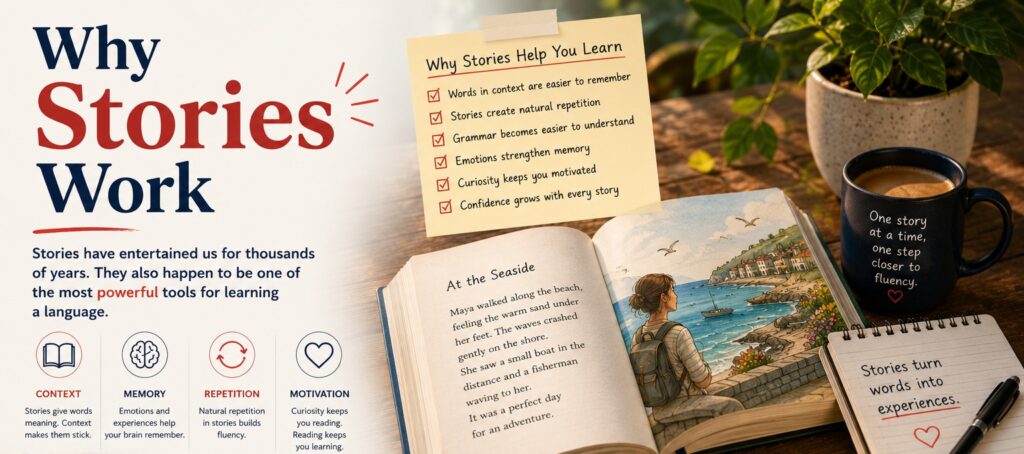
Stories have entertained us for thousands of years. They also happen to be one of the most powerful tools for learning a language.
We Are Wired for Stories
Long before schools, textbooks and language apps existed, people learned through stories.
Parents told stories to their children. Elders shared stories around the fire. Travellers brought stories from distant places. History, traditions and knowledge were passed from one generation to the next, not as lists of facts, but as narratives filled with people, places and emotions.
Even today, stories remain one of the easiest ways to remember information.
Think about the last novel you enjoyed or the last film you watched. Chances are you can still remember the main characters, the plot and perhaps even some memorable lines.
Now compare that with the vocabulary list you studied three months ago.
Which do you remember more clearly?
The answer is obvious.
Our brains are naturally drawn to stories because stories create meaning.
Language Needs Context
Imagine you are learning the word passport.
You could memorise a definition.
Passport – an official document used for international travel.
That works—for a while.
Now imagine reading a story about Emma, who arrives at the airport only to discover she has left her passport at home. She rushes back, almost misses her flight and finally boards the plane just in time.
In that story, the word passport is no longer just a definition.
It becomes part of an event.
You remember the stress, the airport, the journey and the solution.
The vocabulary is connected to an experience rather than existing on its own.
That connection makes the word much easier to remember.
Stories Turn Words into Experiences
A language is more than individual words.
It is a collection of situations.
People apologise.
Friends laugh together.
Families eat dinner.
Travellers ask for directions.
Neighbours help each other.
Stories recreate these situations.
Instead of learning isolated vocabulary, readers experience language as it is actually used.
You don’t simply learn the word restaurant.
You read about someone ordering dinner.
You don’t just learn rain.
You read about someone running through the rain to catch the last bus.
Words become part of a meaningful picture.
That is how language works in real life.
Repetition Without Boredom
One of the greatest challenges in language learning is repetition.
A new word must appear many times before it becomes familiar.
Unfortunately, repetition is often associated with boredom.
Repeat the list.
Repeat the sentence.
Repeat the exercise.
Again.
And again.
Stories solve this problem differently.
Suppose you read ten stories about everyday life.
The words house, kitchen, family, friend, coffee and morning naturally appear again and again.
You aren’t repeating them because someone told you to.
You encounter them because they belong in the story.
The repetition feels natural instead of forced.
And because each story is slightly different, every encounter strengthens your understanding.
Grammar Becomes Easier
Many learners believe grammar has to be mastered before reading.
In reality, reading often makes grammar easier.
Imagine seeing the same sentence pattern dozens of times in different stories.
Without trying, you begin to recognise how the language works.
Your brain starts predicting what comes next.
Eventually, certain structures simply “sound right.”
This doesn’t mean grammar explanations are unnecessary.
They can be very helpful.
But explanations become much easier to understand after you’ve already met the pattern several times in real situations.
Stories give grammar a purpose.
Instead of studying rules in isolation, you see how those rules help people communicate.
Stories Keep You Curious
Perhaps the greatest advantage of stories is that they answer a simple question:
“What happens next?”
Curiosity keeps us reading.
When a character misses a train, loses a wallet or prepares for an important interview, we want to know the outcome.
That curiosity creates motivation.
Instead of reading because you have to, you read because you want to.
The language becomes the bridge to the story rather than the obstacle standing in its way.
This is one reason many learners read far more than they ever expected.
They begin reading for practice.
They continue reading because they are interested.
Emotions Help Memory
Scientists have long known that emotions influence memory.
Moments that make us laugh, surprise us or create suspense tend to stay with us longer than neutral information.
Stories naturally contain emotion.
A happy ending.
A misunderstanding.
A funny conversation.
A difficult decision.
These emotional moments create stronger memories.
If an important word appears during one of those moments, it is more likely to be remembered.
This is another reason stories outperform isolated vocabulary lists.
The words become attached to emotions instead of existing as abstract information.
Reading Builds Confidence
Many learners feel nervous when they open their first book in a foreign language.
They worry about unknown words.
They fear they won’t understand.
But something interesting happens after a few weeks of reading graded stories.
The number of unknown words begins to shrink.
Sentences become easier.
Pages turn more quickly.
Instead of stopping every few lines, learners begin reading continuously.
That growing confidence often becomes the turning point in their language journey.
They stop thinking of themselves as students struggling through exercises.
They begin thinking of themselves as readers.
Stories Create Habits
Good habits are easier to build when the activity is enjoyable.
Few people look forward to memorising another list of verbs after a long day at work.
Many people, however, enjoy reading one more chapter before going to bed.
That difference matters.
Language learning is not about one perfect study session.
It is about showing up consistently.
Stories encourage that consistency because they offer a reason to come back tomorrow.
There is always another chapter.
Another adventure.
Another conversation waiting to be discovered.
Why Fluent15 Uses Stories
Every Fluent15 course is built around carefully graded stories.
Each story introduces useful vocabulary in meaningful situations while gently reinforcing words and grammar from previous lessons.
The goal is never simply to finish another exercise.
The goal is to enjoy reading while your language skills grow naturally in the background.
Some stories are humorous.
Others are practical.
Some take place in airports, cafés or supermarkets.
Others explore history, travel or everyday life.
What they all have in common is that they make language feel alive.
The Real Goal
Reading stories will not teach you every word in a language.
No single method can do that.
What stories can do is something even more valuable.
They help you become comfortable with the language.
Comfort leads to confidence.
Confidence leads to more reading.
More reading leads to better vocabulary, stronger grammar and greater fluency.
That is why stories are at the heart of the Fluent15 Method.
Not because they are entertaining—although they often are.
But because they allow language to be learned in the way it is meant to be experienced: through meaningful, memorable communication.
Key Takeaways
- Stories provide meaningful context that makes vocabulary easier to remember.
- Natural repetition is more effective than mechanical repetition.
- Reading helps learners recognise grammar patterns through repeated exposure.
- Curiosity and emotion increase motivation and strengthen memory.
- Regular reading builds confidence and creates sustainable learning habits.
- Stories transform language learning from a study task into an enjoyable experience.
Continue Reading
Want to discover more about learning through reading?
Continue with:
- Why 15 Minutes Is Enough
- Why We Don’t Memorize Vocabulary Lists
- Extensive Reading Explained
Or explore one of our graded story collections and experience how stories can turn everyday reading into meaningful language learning.