
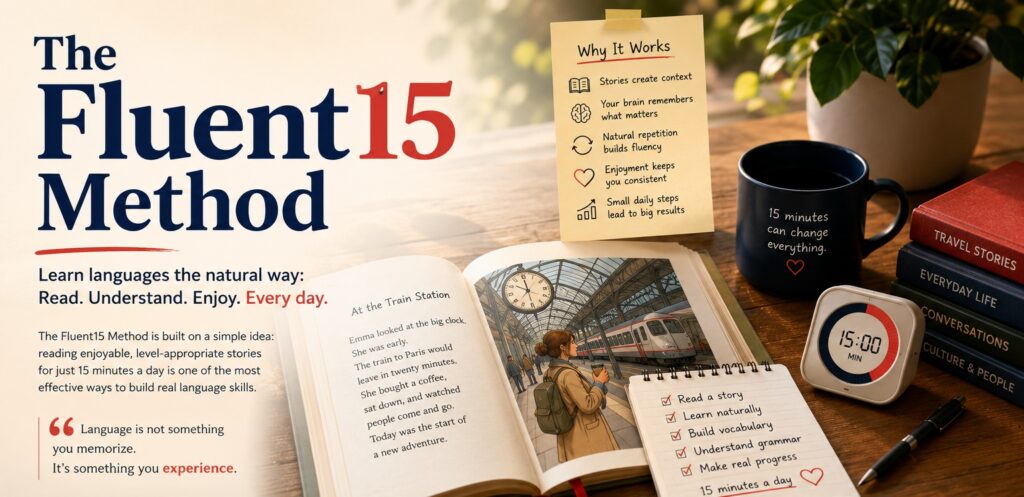
Why reading isn’t the reward for learning a language—it is the way you learn one.
A Different Way to Learn
Think back to your very first language lesson. You were probably given a list of words to memorise, a few grammar rules to study, and perhaps some exercises to complete. After a while, you were expected to read a short text using the vocabulary and grammar you had just learned.
For decades, this has been the standard approach to language learning. First study the language, then use it.
At Fluent15, we believe the order should be reversed.
Instead of spending months preparing to read, we believe learners should begin reading as early as possible. Not difficult novels or newspaper articles, but carefully written stories that match their current level.
Reading is not the final step in learning a language. It is the engine that drives the entire process.
That simple idea is the foundation of the Fluent15 Method.
Learning a Language Is Like Learning to Swim
Imagine someone who wants to learn swimming.
They could spend weeks reading books about swimming techniques, watching videos, memorising the names of different strokes and studying the physics of floating. They might become an expert in swimming theory—but none of that would make them a swimmer.
At some point, they have to get into the water.
Language learning works in much the same way.
Grammar books, vocabulary lists and exercises all have their place, but they cannot replace meaningful exposure to the language itself. To become comfortable with a language, you need to experience it over and over again in real situations.
Reading provides exactly that experience.
Every story becomes another opportunity to meet familiar words, discover new expressions and recognise grammar patterns naturally.
The Problem With Traditional Language Learning
Many learners become trapped in an endless cycle.
They memorise vocabulary for a test.
A week later, they have forgotten most of it.
They study another list.
Then another.
Soon they know hundreds of isolated words, but they still struggle to understand a simple story or hold a conversation.
The problem is not a lack of effort.
It is the way the information is presented.
Words learned in isolation have very little meaning. Without context, the brain has nothing to connect them to. They remain isolated pieces of information that are easily forgotten.
Real language, however, is never isolated.
Words appear in sentences.
Sentences form conversations.
Conversations become stories.
The more meaningful the context, the easier it becomes for the brain to remember what it has seen.
Why Stories Make Learning Easier
Humans are natural storytellers.
Long before books existed, people shared knowledge through stories. We remember adventures, conversations and emotions far more easily than disconnected facts.
Think about the last film you watched.
You probably remember the characters, the places they visited and many of the conversations. You may even remember exact lines of dialogue.
Now think about a random vocabulary list you studied six months ago.
How many of those words can you still recall?
Stories give words a purpose.
Instead of simply learning that airport means a place where planes arrive and depart, you read about someone missing a flight, searching for the correct gate or meeting a friend after a long journey.
The vocabulary becomes part of an experience.
Experiences are memorable.
Reading Creates Thousands of Natural Repetitions
One of the biggest challenges in language learning is repetition.
A new word needs to be encountered many times before it becomes part of your active vocabulary. Traditional courses often solve this by asking learners to repeat the same word again and again.
Reading achieves repetition in a much more natural way.
Imagine reading ten short stories about travelling.
Words such as passport, ticket, station, hotel, train and luggage appear again and again.
You are not studying these words directly.
You are simply following the story.
Yet every encounter strengthens your memory.
Over time, those words become familiar without deliberate memorisation.
Grammar Without Memorising Rules
Grammar is often seen as the most difficult part of learning a language.
Many learners spend hours studying rules before they feel confident enough to use them.
The Fluent15 Method takes a different approach.
Rather than introducing every grammar rule first, we allow learners to meet grammar naturally through reading.
When you repeatedly see the same sentence structures in meaningful contexts, your brain begins to recognise patterns.
Children learn their first language this way.
They do not begin by studying grammar textbooks.
They hear, read and experience language until the patterns feel natural.
Adult learners can benefit from the same principle.
Grammar explanations remain useful, especially when they clarify difficult structures, but they become much easier to understand after learners have already seen those structures in real stories.
Learning at the Right Level
One of the most common reasons learners become discouraged is that they choose material that is simply too difficult.
A beginner who tries to read a newspaper quickly becomes overwhelmed.
Looking up every second word is exhausting.
Reading stops being enjoyable.
The Fluent15 Method is built around graded reading.
Every story is written for a specific level.
That means learners understand most of what they read while still encountering enough new vocabulary to continue making progress.
This balance is important.
Material that is too easy provides little challenge.
Material that is too difficult creates frustration.
The best learning happens somewhere in between.
Why Fifteen Minutes Matters
People often believe they need hours every day to make meaningful progress.
In reality, consistency matters far more than long study sessions.
Fifteen focused minutes of reading every day equals more than ninety hours of reading each year.
That is enough time to read hundreds of graded stories and encounter tens of thousands of words in meaningful contexts.
More importantly, fifteen minutes feels achievable.
Busy schedules rarely allow two-hour study sessions every day.
Most people can, however, find fifteen quiet minutes during breakfast, on the train or before going to bed.
Learning becomes a habit rather than a chore.
Progress You Can Feel
One of the most satisfying moments in language learning is returning to something that once seemed impossible.
A story that felt difficult a month ago suddenly feels easy.
Words that once required a dictionary now appear familiar.
Sentences begin to flow naturally.
This kind of progress rarely happens overnight.
It happens through hundreds of small improvements that slowly build confidence.
Every story adds another piece to the puzzle.
Every page read strengthens your understanding.
The goal is not perfection.
The goal is continuous growth.
More Than Reading
Although reading sits at the heart of the Fluent15 Method, it is not the only tool we use.
Our courses combine carefully graded stories with vocabulary support, comprehension activities and practical learning resources designed to reinforce what learners have just experienced.
Everything is built around one simple principle:
Language should always be learned through meaningful context.
Whether you are exploring everyday conversations, travelling, ordering food or reading about history, every lesson should feel connected to real life.
Learning That Lasts
There are many ways to study a language.
Some people enjoy grammar exercises.
Others prefer flashcards.
Many combine several different methods.
The Fluent15 Method does not claim that reading is the only way to learn.
Instead, it recognises something supported by both research and experience: learners improve most when they spend large amounts of time engaging with language they can understand.
Reading provides that opportunity.
It builds vocabulary naturally.
It reinforces grammar without constant explanation.
It improves comprehension.
It increases confidence.
Most importantly, it transforms language learning from an endless cycle of memorisation into something enjoyable.
When learners enjoy the process, they continue.
When they continue, they improve.
And improvement is what every language learner is ultimately looking for.
Key Takeaways
- Reading is not the reward after learning a language—it is one of the most effective ways to learn it.
- Stories provide meaningful context that makes vocabulary easier to remember.
- Frequent exposure is more valuable than isolated memorisation.
- Graded reading helps learners progress without becoming overwhelmed.
- Fifteen minutes of consistent daily reading can lead to remarkable long-term progress.
- The goal is not to memorise a language, but to experience it often enough that understanding becomes natural.
Continue Reading
If you’d like to explore the ideas behind the Fluent15 Method in more detail, continue with these articles:
- Why Stories Work
- Why 15 Minutes Is Enough
- Why We Don’t Memorize Vocabulary Lists
- Extensive Reading Explained
Or, if you’re ready to put the method into practice, explore one of our graded reading courses and experience how learning through stories can transform the way you learn a language.